HISTORIC MARKER DEDICATED TO DEWITT CLINTON HOME INSTALLED IN MASPETH
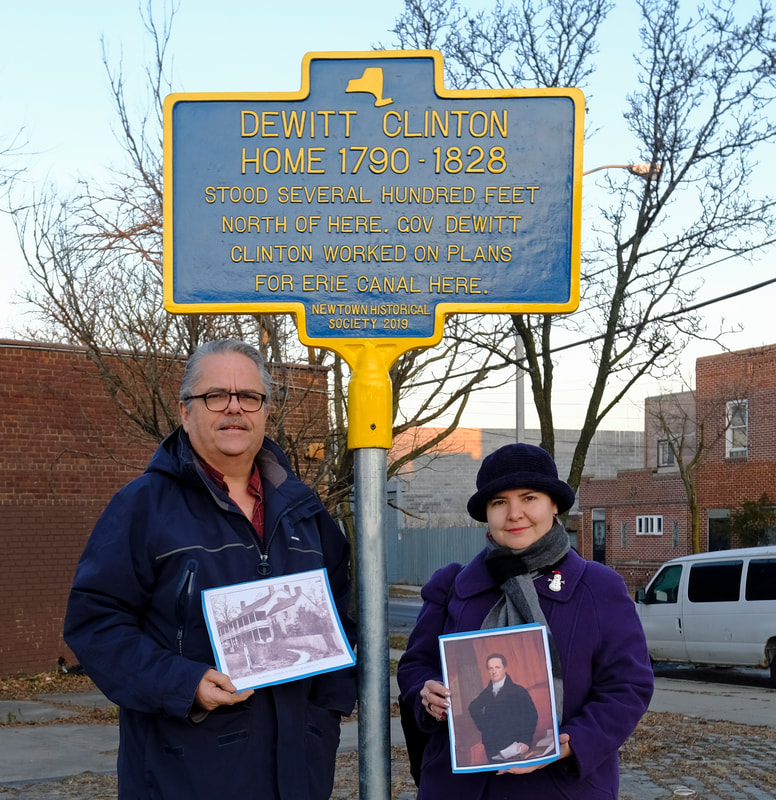
(MASPETH, NY; December 22, 2019) The Newtown Historical Society’s 2-year mission to replace a long-lost roadside historic marker that notes the former location of the mansion of Governor DeWitt Clinton, the “Father of the Erie Canal,” was finally accomplished this month. The marker replaces one that was originally installed in the 1930s and is located at the triangular park at the intersection of Maspeth Ave, 56th Terrace and 58th Street.
Governor Clinton (1769-1828) is believed to have planned the Erie Canal at his Maspeth summer home, which he and his wife Maria inherited from his father-in-law, Walter Franklin. The mansion stood very close to Newtown Landing, the historic town dock. The house burned down in 1933 after many years of neglect. Shortly after, an historic marker was placed to note the location of the local landmark by the NYS Department of Education’s State History Office, indicating that it had statewide importance. It is believed that the marker disappeared decades ago when the roads were widened and reconfigured.
“While doing historic research back in 2017, I came across a photo of the old marker that was at the intersection,” said Newtown Historical Society President Christina Wilkinson. “I thought to myself, why couldn’t NHS replace it? There’s a tree-lined plaza at the location now and it would enhance the area while teaching residents about the history of Maspeth.”
State Senator Joseph Addabbo’s office did the research determining that the plaza was owned by the NYC Dept of Transportation. Funding from Council Member Robert Holden covered the cost of the marker. It was purchased from Catskills Castings, which also created the original marker for the State History Office.
Last March, Community Board 2 unanimously voted in favor of supporting the placement of the marker and this past July the NYC Design Commission approved NHS’ application. When Juniper Park Civic Association President Tony Nunziato heard about the project, he arranged for Marco Properties to install the marker, and on December 16th the work was completed. Money collected via a Facebook fundraiser covered the cost of installation.
“Montauk has long been known as ‘The End’ of Long Island,” said Nunziato. “Well, Maspeth is actually ‘The Beginning’ both geographically and historically and this project helps acknowledge that.”
The mansion had a long history that predated Clinton’s time there, including a Revolutionary War connection.
This is the second historic marker that NHS has installed. The first was erected last December at the Ridgewood Reservoir.
Governor Clinton (1769-1828) is believed to have planned the Erie Canal at his Maspeth summer home, which he and his wife Maria inherited from his father-in-law, Walter Franklin. The mansion stood very close to Newtown Landing, the historic town dock. The house burned down in 1933 after many years of neglect. Shortly after, an historic marker was placed to note the location of the local landmark by the NYS Department of Education’s State History Office, indicating that it had statewide importance. It is believed that the marker disappeared decades ago when the roads were widened and reconfigured.
“While doing historic research back in 2017, I came across a photo of the old marker that was at the intersection,” said Newtown Historical Society President Christina Wilkinson. “I thought to myself, why couldn’t NHS replace it? There’s a tree-lined plaza at the location now and it would enhance the area while teaching residents about the history of Maspeth.”
State Senator Joseph Addabbo’s office did the research determining that the plaza was owned by the NYC Dept of Transportation. Funding from Council Member Robert Holden covered the cost of the marker. It was purchased from Catskills Castings, which also created the original marker for the State History Office.
Last March, Community Board 2 unanimously voted in favor of supporting the placement of the marker and this past July the NYC Design Commission approved NHS’ application. When Juniper Park Civic Association President Tony Nunziato heard about the project, he arranged for Marco Properties to install the marker, and on December 16th the work was completed. Money collected via a Facebook fundraiser covered the cost of installation.
“Montauk has long been known as ‘The End’ of Long Island,” said Nunziato. “Well, Maspeth is actually ‘The Beginning’ both geographically and historically and this project helps acknowledge that.”
The mansion had a long history that predated Clinton’s time there, including a Revolutionary War connection.
This is the second historic marker that NHS has installed. The first was erected last December at the Ridgewood Reservoir.
Newtown Historical Society calls on Queens elected officials to fund acquisition of Brinckerhoff Cemetery
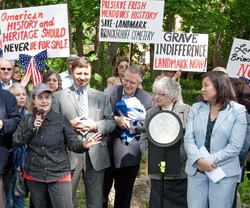
NHS President Christina Wilkinson speaks at
Brinckerhoff Cemetery rally 5/6/12.
Brinckerhoff Cemetery rally 5/6/12.
(May 6, 2012) The Newtown Historical Society stands with the Fresh Meadows Homeowners Civic Association and other civic and preservation organizations across the borough in opposition of the proposed de-calendaring of the Brinckerhoff Cemetery by the Landmarks Preservation Commission. The cemetery holds the remains of some of the earliest settlers of Queens and, as an important historical reminder of our borough’s past, should be designated an official NYC landmark. However, designation is not enough to ensure preservation.
Therefore, NHS calls on the elected officials representing the Fresh Meadows area, the Queens Borough President and Queens delegation of the City Council, to allocate funding toward purchase of the property and return ownership to the City. The property cost $100,000 to purchase in 2000, but that opportunity was unfortunately not capitalized upon. Over the course of the following 10 years, no funding was allocated for this purpose, although elected officials went on record during that time to claim that they supported public ownership of the land as a park or historic site.
The property was sold in 2010 for $105,000 – an increase in price of only $5,000 after 10 years. Surely, most - if not all - of this funding can be raised during the City’s upcoming June budget cycle to purchase the property from the current owner and assure that this land is forever saved from the threat of development. The Queens delegation recently allocated a lump sum of $3M toward purchase of a schoolyard in Jackson Heights for part-time use as a park. It is time for Queens’ elected officials to step up to the plate and put their money where their mouths are so we will not need any more hearings or rallies to push for a solution which should have come to pass decades ago.
Brinckerhoff Cemetery was also once known as "Black Stump Cemetery" and is located at 69-65 182nd Street in Fresh Meadows, Queens.
Therefore, NHS calls on the elected officials representing the Fresh Meadows area, the Queens Borough President and Queens delegation of the City Council, to allocate funding toward purchase of the property and return ownership to the City. The property cost $100,000 to purchase in 2000, but that opportunity was unfortunately not capitalized upon. Over the course of the following 10 years, no funding was allocated for this purpose, although elected officials went on record during that time to claim that they supported public ownership of the land as a park or historic site.
The property was sold in 2010 for $105,000 – an increase in price of only $5,000 after 10 years. Surely, most - if not all - of this funding can be raised during the City’s upcoming June budget cycle to purchase the property from the current owner and assure that this land is forever saved from the threat of development. The Queens delegation recently allocated a lump sum of $3M toward purchase of a schoolyard in Jackson Heights for part-time use as a park. It is time for Queens’ elected officials to step up to the plate and put their money where their mouths are so we will not need any more hearings or rallies to push for a solution which should have come to pass decades ago.
Brinckerhoff Cemetery was also once known as "Black Stump Cemetery" and is located at 69-65 182nd Street in Fresh Meadows, Queens.
COUNCIL MEMBER ELIZABETH CROWLEY DASHES HOPES FOR ST. SAVIOUR’S PARK SPACE
Impetuous decision has dire consequences
(November 14, 2011) Last week, park and community advocates including the Juniper Park Civic Association, Newtown Historical Society and NYC Park Advocates were shocked to learn that the City’s Department of Parks and Recreation and Council Member Elizabeth Crowley have dropped their bid to acquire the 1.5-acre former site of St. Saviour’s Church in Maspeth, Queens. The groups had been working for 5 years to have this site converted into parkland before the decision to quit was made by city officials without any community notification or input.
“I was dumbfounded when I received a call from a Daily News reporter on Thursday, November 10th, asking me for my reaction to the Parks Dept’s decision to nix the acquisition of the St. Saviour’s site,” said Christina Wilkinson, President of Newtown Historical Society. “It was news to me and every other volunteer involved in this project. As late as November 1st, Parks had indicated that they were ready to proceed with ULURP if and when the elected officials were to raise the money required for the process and we had been working up until this point to find this money.”
Crowley had called Wilkinson personally on Tuesday, November 8th and told her of the opportunity to acquire a 14,875 sq ft property at the corner of 61st Street and Maspeth Avenue from Martin Luther School, which currently uses the site as an accessory parking lot. Crowley said she needed to use the money she had already raised for St. Saviour’s or she might lose it during the City’s upcoming budget modification process. It should be noted that the loss of elected officials’ allocated capital funding happens frequently. It may delay projects, but it rarely kills them. It is incumbent upon elected officials to replace lost monies during subsequent budgets and to seek out and lobby for Mayoral, Speaker and Queens Delegation funding. (During her time in the City Council, Elizabeth Crowley has not secured a dime of funding from any of these sources and this year did not put any money toward the St. Saviour’s acquisition.)
Crowley said that Parks was on board with acquiring the Martin Luther site and had asked DCAS to appraise the property so that negotiations with the school could commence.
“Crowley assured me that it was her intention to use some of her funding toward the Martin Luther site, and then continue to seek other green space in Maspeth, including the St. Saviour’s site,” Wilkinson said. “I took her at her word. She asked me to gather community feedback on her proposal. I was in the process of doing so when I found out that she had gone to the Daily News with her idea and was pitching the Martin Luther site as a “replacement” for the St. Saviour’s site. I can’t believe they torpedoed this project which has borough-wide and city hall support, in return for a much smaller site that is nothing but a maybe at this point and is not in jeopardy of being sold or developed as the St. Saviour’s site is.”
The irresponsible decision by Council Member Crowley and the Parks Dept to prematurely announce the non-guaranteed acquisition of the 14,785 sq ft Martin Luther site as a “replacement” for the 62,500 sq ft. St. Saviour's project means that the original project is most likely ineligible for $1.2M from the Newtown Creek Wastewater Treatment Plant Mitigation Funding that it was being considered for. St. Saviour's had been listed as a priority 2 finalist, which meant it could have been eligible for funding had any of the four priority 1 projects been found to be unfeasible. As was mentioned in the DEC letter to the City Parks Foundation dated 10/25/11, the determination of the feasibility is to be made within 60 days, or by December 25th. In addition, as of November 11th, State Senator Joseph Addabbo was waiting for a return call from DEC regarding $300,000 of unallocated priority 1 settlement money and if some of it could be used to cover the St. Saviour’s ULURP fees now. Addabbo also was in the process of finding out whether part of a grant from his predecessor, former State Senator Serf Maltese, could have covered the ULURP costs. Assembly Member Cathy Nolan was quoted in a story by the Times Ledger dated 11/12, “I will be working with other elected officials to advocate again for St. Saviour’s. The destruction of the church and yard has been a tragedy that needs to be addressed.” Apparently, Crowley never informed the other elected officials representing the area about her plan to pull the rug out from under St. Saviour’s in order to claim a win at the Martin Luther site.
This unforeseen development also means that the tentative offer secured by Maspeth activist Tony Nunziato from NYSDOT to fund the construction of the park at St. Saviour’s as part of the Kosciuszko bridge replacement project is also in jeopardy. Elizabeth Crowley could not wait to run to the media and announce her "Maspeth park victory" – in effect, disqualifying the community from receiving funding for the only project it had on the DEC and NYSDOT lists and slapping her own colleagues in the face in the process.
Juniper Park Civic Association President Robert Holden said, “Unfortunately it appears that Councilwoman Elizabeth Crowley has given up the fight to save one of the most historic sites in the City of New York and Maspeth’s most important landmark. I’m not surprised. After failing to convince city officials of its importance, Crowley has also given up the fight to reassemble St. Saviour’s church, one of the last remaining Carpenter Gothic-style buildings designed by world famous architect, Richard Upjohn in 1847. Saving the church and land were two of Crowley’s campaign promises. While the church still sits in trailers in West Maspeth, the St. Saviour’s historic land now contains warehouses as symbolic and grotesque monuments to the failure of the City of New York and our elected officials to recognize the importance of saving the last remaining landmarks of Maspeth’s history for future generations to enjoy.”
In spite of this avoidable setback, Juniper Park Civic Association, Newtown Historical Society and NYC Park Advocates will not be giving up on their proposal to convert the St. Saviour’s site into a park and we call on the Bloomberg administration and local elected officials to work together toward this goal and make it happen. Maspeth is sorely underserved by parkland and needs and deserves to have the historic St. Saviour’s site, the last sizable piece of open space left in the area, preserved as a park.
(November 14, 2011) Last week, park and community advocates including the Juniper Park Civic Association, Newtown Historical Society and NYC Park Advocates were shocked to learn that the City’s Department of Parks and Recreation and Council Member Elizabeth Crowley have dropped their bid to acquire the 1.5-acre former site of St. Saviour’s Church in Maspeth, Queens. The groups had been working for 5 years to have this site converted into parkland before the decision to quit was made by city officials without any community notification or input.
“I was dumbfounded when I received a call from a Daily News reporter on Thursday, November 10th, asking me for my reaction to the Parks Dept’s decision to nix the acquisition of the St. Saviour’s site,” said Christina Wilkinson, President of Newtown Historical Society. “It was news to me and every other volunteer involved in this project. As late as November 1st, Parks had indicated that they were ready to proceed with ULURP if and when the elected officials were to raise the money required for the process and we had been working up until this point to find this money.”
Crowley had called Wilkinson personally on Tuesday, November 8th and told her of the opportunity to acquire a 14,875 sq ft property at the corner of 61st Street and Maspeth Avenue from Martin Luther School, which currently uses the site as an accessory parking lot. Crowley said she needed to use the money she had already raised for St. Saviour’s or she might lose it during the City’s upcoming budget modification process. It should be noted that the loss of elected officials’ allocated capital funding happens frequently. It may delay projects, but it rarely kills them. It is incumbent upon elected officials to replace lost monies during subsequent budgets and to seek out and lobby for Mayoral, Speaker and Queens Delegation funding. (During her time in the City Council, Elizabeth Crowley has not secured a dime of funding from any of these sources and this year did not put any money toward the St. Saviour’s acquisition.)
Crowley said that Parks was on board with acquiring the Martin Luther site and had asked DCAS to appraise the property so that negotiations with the school could commence.
“Crowley assured me that it was her intention to use some of her funding toward the Martin Luther site, and then continue to seek other green space in Maspeth, including the St. Saviour’s site,” Wilkinson said. “I took her at her word. She asked me to gather community feedback on her proposal. I was in the process of doing so when I found out that she had gone to the Daily News with her idea and was pitching the Martin Luther site as a “replacement” for the St. Saviour’s site. I can’t believe they torpedoed this project which has borough-wide and city hall support, in return for a much smaller site that is nothing but a maybe at this point and is not in jeopardy of being sold or developed as the St. Saviour’s site is.”
The irresponsible decision by Council Member Crowley and the Parks Dept to prematurely announce the non-guaranteed acquisition of the 14,785 sq ft Martin Luther site as a “replacement” for the 62,500 sq ft. St. Saviour's project means that the original project is most likely ineligible for $1.2M from the Newtown Creek Wastewater Treatment Plant Mitigation Funding that it was being considered for. St. Saviour's had been listed as a priority 2 finalist, which meant it could have been eligible for funding had any of the four priority 1 projects been found to be unfeasible. As was mentioned in the DEC letter to the City Parks Foundation dated 10/25/11, the determination of the feasibility is to be made within 60 days, or by December 25th. In addition, as of November 11th, State Senator Joseph Addabbo was waiting for a return call from DEC regarding $300,000 of unallocated priority 1 settlement money and if some of it could be used to cover the St. Saviour’s ULURP fees now. Addabbo also was in the process of finding out whether part of a grant from his predecessor, former State Senator Serf Maltese, could have covered the ULURP costs. Assembly Member Cathy Nolan was quoted in a story by the Times Ledger dated 11/12, “I will be working with other elected officials to advocate again for St. Saviour’s. The destruction of the church and yard has been a tragedy that needs to be addressed.” Apparently, Crowley never informed the other elected officials representing the area about her plan to pull the rug out from under St. Saviour’s in order to claim a win at the Martin Luther site.
This unforeseen development also means that the tentative offer secured by Maspeth activist Tony Nunziato from NYSDOT to fund the construction of the park at St. Saviour’s as part of the Kosciuszko bridge replacement project is also in jeopardy. Elizabeth Crowley could not wait to run to the media and announce her "Maspeth park victory" – in effect, disqualifying the community from receiving funding for the only project it had on the DEC and NYSDOT lists and slapping her own colleagues in the face in the process.
Juniper Park Civic Association President Robert Holden said, “Unfortunately it appears that Councilwoman Elizabeth Crowley has given up the fight to save one of the most historic sites in the City of New York and Maspeth’s most important landmark. I’m not surprised. After failing to convince city officials of its importance, Crowley has also given up the fight to reassemble St. Saviour’s church, one of the last remaining Carpenter Gothic-style buildings designed by world famous architect, Richard Upjohn in 1847. Saving the church and land were two of Crowley’s campaign promises. While the church still sits in trailers in West Maspeth, the St. Saviour’s historic land now contains warehouses as symbolic and grotesque monuments to the failure of the City of New York and our elected officials to recognize the importance of saving the last remaining landmarks of Maspeth’s history for future generations to enjoy.”
In spite of this avoidable setback, Juniper Park Civic Association, Newtown Historical Society and NYC Park Advocates will not be giving up on their proposal to convert the St. Saviour’s site into a park and we call on the Bloomberg administration and local elected officials to work together toward this goal and make it happen. Maspeth is sorely underserved by parkland and needs and deserves to have the historic St. Saviour’s site, the last sizable piece of open space left in the area, preserved as a park.
NHS replaces plaque dedicated to Astoria's Hallett family
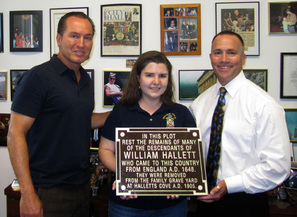
Photo, left to right: Council Member Peter Vallone, Jr., NHS President Christina Wilkinson and Dr. William C. Hallett display Hallett Family memorial plaque now in Mount Olivet Cemetery.
August 22, 2011: The Newtown Historical Society is proud to announce the replacement of an historic plaque dedicated to Astoria’s founding family, the Halletts, at Mount Olivet Cemetery in Maspeth.
The Hallett family, led by patriarch William Hallett, emigrated from England and settled in Greenwich, Connecticut in 1648, but moved in 1652 to 160 acres in the Hallett’s Cove area of Astoria. In 1664, William Hallett expanded his holding to 2,200 acres, which included all of modern-day Astoria. Several generations of Halletts lived on the property and as was customary at the time, family members that died were buried near their home. The Hallett cemetery was located between Astoria Blvd and Main Avenue. Over time, the family’s land was divided into parcels and sold.
As explained by Vincent Seyfried in his book, 300 Years of Long Island City: 1630-1930, “All the 50 bodies in the burial plot, 35 of them Halletts dating from 1724 to 1861, were transferred to Mount Olivet Cemetery in April 1905 and the stones were re-cut and re-erected over the new graves.”
The original historical plaque that recorded this event had been weathered to the point where some of the writing on it was no longer readable.
“We don’t want barriers such as illegible writing to prevent Queens residents from understanding their history, so our board decided that replacing the plaque was the right thing to do,” explained Newtown Historical Society President Christina Wilkinson. “We thank Council Member Peter Vallone, Jr. for his assistance in making this happen.”
Council Member Peter F. Vallone, Jr. was instrumental in locating and obtaining permission from the descendants of William Hallett.
Vallone made contact with Dr. William C. Hallett, a Nassau County-based pharmacy consultant and direct descendant of the original William Hallett. Dr. Hallett is proud of his family’s history and is in possession of many documents dating back 300 years or more. The Hallett family history stretches across the borough to Flushing and Jamaica, but they are best known as being among the first settlers of Astoria.
"Astoria has a rich and storied history, and the Hallett family is proud to be a part of it,” said Dr. William C. Hallett. “We are deeply appreciative of the efforts of the Newtown Historical Society and Council Member Vallone to replace the plaque, and helping to preserve the history and heritage of our area."
“I commend Newtown Historical Society for being proactive and restoring this important link to Queens history. I thought my family had deep Queens roots, but the Halletts definitely have us all beat,” said Council Member Vallone. “Queens is a great place to call home, whether it’s your first year in the borough or your family’s 350th.”
The inscription on the new plaque, which is identical to the one on the old plaque, reads:
“In this plot rest the remains of many of the descendants of William Hallett who came to this country from England A.D. 1648. They were removed from the family grave yard at Hallett’s Cove A.D. 1905.”
August 22, 2011: The Newtown Historical Society is proud to announce the replacement of an historic plaque dedicated to Astoria’s founding family, the Halletts, at Mount Olivet Cemetery in Maspeth.
The Hallett family, led by patriarch William Hallett, emigrated from England and settled in Greenwich, Connecticut in 1648, but moved in 1652 to 160 acres in the Hallett’s Cove area of Astoria. In 1664, William Hallett expanded his holding to 2,200 acres, which included all of modern-day Astoria. Several generations of Halletts lived on the property and as was customary at the time, family members that died were buried near their home. The Hallett cemetery was located between Astoria Blvd and Main Avenue. Over time, the family’s land was divided into parcels and sold.
As explained by Vincent Seyfried in his book, 300 Years of Long Island City: 1630-1930, “All the 50 bodies in the burial plot, 35 of them Halletts dating from 1724 to 1861, were transferred to Mount Olivet Cemetery in April 1905 and the stones were re-cut and re-erected over the new graves.”
The original historical plaque that recorded this event had been weathered to the point where some of the writing on it was no longer readable.
“We don’t want barriers such as illegible writing to prevent Queens residents from understanding their history, so our board decided that replacing the plaque was the right thing to do,” explained Newtown Historical Society President Christina Wilkinson. “We thank Council Member Peter Vallone, Jr. for his assistance in making this happen.”
Council Member Peter F. Vallone, Jr. was instrumental in locating and obtaining permission from the descendants of William Hallett.
Vallone made contact with Dr. William C. Hallett, a Nassau County-based pharmacy consultant and direct descendant of the original William Hallett. Dr. Hallett is proud of his family’s history and is in possession of many documents dating back 300 years or more. The Hallett family history stretches across the borough to Flushing and Jamaica, but they are best known as being among the first settlers of Astoria.
"Astoria has a rich and storied history, and the Hallett family is proud to be a part of it,” said Dr. William C. Hallett. “We are deeply appreciative of the efforts of the Newtown Historical Society and Council Member Vallone to replace the plaque, and helping to preserve the history and heritage of our area."
“I commend Newtown Historical Society for being proactive and restoring this important link to Queens history. I thought my family had deep Queens roots, but the Halletts definitely have us all beat,” said Council Member Vallone. “Queens is a great place to call home, whether it’s your first year in the borough or your family’s 350th.”
The inscription on the new plaque, which is identical to the one on the old plaque, reads:
“In this plot rest the remains of many of the descendants of William Hallett who came to this country from England A.D. 1648. They were removed from the family grave yard at Hallett’s Cove A.D. 1905.”
"Maspeth in the 1940s" exhibit now on display at Maspeth Federal Savings
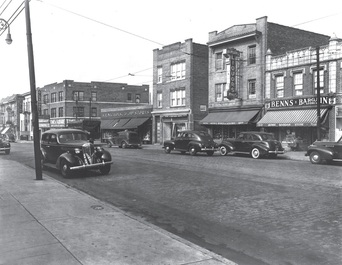
Grand Avenue streetscape in 1949
(September 25, 2010) The Newtown Historical Society is proud to present our second exhibit, “Maspeth in the 1940s” at Maspeth Federal Savings, located at 58-15 69th Street in Maspeth, Queens. The exhibit is currently displayed in the windows of the recently renovated and upgraded bank building and is viewable from the street. The exhibit is ongoing. This photo series is being presented in conjunction with Q Gardens Gallery, owned and operated by historian Ron Marzlock.
The photos depict life in Maspeth before, during and after WWII. Featured are photos of the opening of Maurice Park in 1940 taken by Stella Wolinski, grandmother of Christina Wilkinson, president of the Newtown Historical Society. "I am pleased to be able to share my grandmother's unique photos of this historic Maspeth event. You can learn a lot about a neighborhood's past by looking through personal photo collections," Wilkinson said. Many of the photos are Grand Avenue street scenes; prominently shown in these are the trolleys that used to travel along the road. Other photos focus on the stores that sustained the community through good times and bad. One subset reveals the interior of a cigar-and-candy store of the time.
“We are very excited to host this exhibit. Maspeth is a community rich in history, and having people look back at these pictures is wonderful,” said David Daraio, Assistant Vice President of Maspeth Federal Savings.
The Newtown Historical Society will be presenting more photo exhibits, as well as slideshows, lectures and walking tours throughout the upcoming year. A walking tour of Maspeth is being planned for the Fall, and upcoming slideshows will include topics such as the development of western Queens neighborhoods, the story of the Newtown Pippin apple and the history of the Ridgewood Reservoir.
For more information about the Maspeth photo exhibit or to join the Newtown Historical Society, please visit www.newtownhistorical.org or call 718-366-3715.
The photos depict life in Maspeth before, during and after WWII. Featured are photos of the opening of Maurice Park in 1940 taken by Stella Wolinski, grandmother of Christina Wilkinson, president of the Newtown Historical Society. "I am pleased to be able to share my grandmother's unique photos of this historic Maspeth event. You can learn a lot about a neighborhood's past by looking through personal photo collections," Wilkinson said. Many of the photos are Grand Avenue street scenes; prominently shown in these are the trolleys that used to travel along the road. Other photos focus on the stores that sustained the community through good times and bad. One subset reveals the interior of a cigar-and-candy store of the time.
“We are very excited to host this exhibit. Maspeth is a community rich in history, and having people look back at these pictures is wonderful,” said David Daraio, Assistant Vice President of Maspeth Federal Savings.
The Newtown Historical Society will be presenting more photo exhibits, as well as slideshows, lectures and walking tours throughout the upcoming year. A walking tour of Maspeth is being planned for the Fall, and upcoming slideshows will include topics such as the development of western Queens neighborhoods, the story of the Newtown Pippin apple and the history of the Ridgewood Reservoir.
For more information about the Maspeth photo exhibit or to join the Newtown Historical Society, please visit www.newtownhistorical.org or call 718-366-3715.
Flushing Avenue photos now available online for purchase
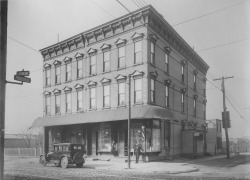
Woodward Avenue at Flushing Avenue
The photos from our exhibit, "A Walk Down Flushing Avenue, 1929" are now available for purchase. Please click here to go to photo gallery.
Recent articles about St. Saviour's park fight
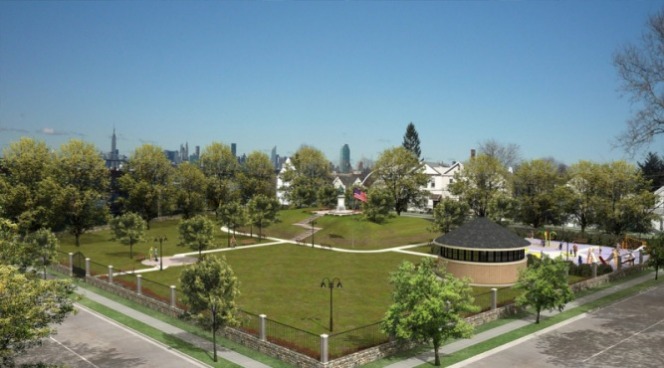
Preservationists present plans for St. Saviour’s site [Ridgewood Ledger]
EPF cuts endanger St. Saviour’s plans [Queens Chronicle]
Vision for a New Park [Times Newsweekly]
Vision for St. Saviour's Parkland is Unveiled [Forum West]
EPF cuts endanger St. Saviour’s plans [Queens Chronicle]
Vision for a New Park [Times Newsweekly]
Vision for St. Saviour's Parkland is Unveiled [Forum West]
Newtown exhibit featured in local newspapers
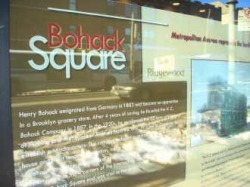
Bank’s exhibit offers glimpse at history [Queens Chronicle]
Take A Look Back At History And A Walk On Flushing Ave. [Times Newsweekly]
Take A Look Back At History And A Walk On Flushing Ave. [Times Newsweekly]
Newtown Pippin lecture at the First Presbyterian Church of Newtown Sun, Feb 21st
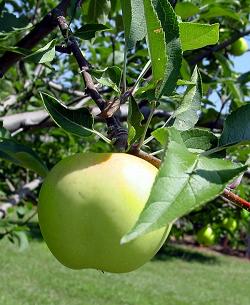
Newtown Pippin on the tree
(February 12, 2010) The Newtown Historical Society will be presenting a free lecture and slideshow about the historic Newtown Pippin apple at the First Presbyterian Church of Newtown located at Queens Blvd & 54th Avenue in Elmhurst, on Sunday, February 21st, 2010 at 12:30pm. The venue was the site of a planting in 2002 which brought the apple back to its area of origin for the first time since the early 19th century. The presentation will explain the history of the apple in Queens and the new replanting project that has been underway for the past year. Speakers will include Bob Singleton, Vice President of the Greater Astoria Historical Society, Erik Baard, Co-founder of the Newtown Pippin Project, and Marjorie Melikian, Historian for the First Presbyterian Church of Newtown. Council Member James Gennaro’s 2009 resolution calling for recognition of the Newtown Pippin as the official apple of the City of New York will also be discussed and samples of the apples will be available for tasting. For more information, please call the Newtown Historical Society at 718-366-3715 or e-mail newtownhistory@gmail.com.
NEWTOWN HISTORICAL SOCIETY PRESENTS "A WALK DOWN FLUSHING AVENUE, 1929" AT MASPETH FEDERAL SAVINGS
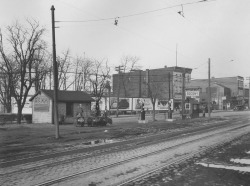
Flushing & Grand Avenues, 1929
(December 14, 2009) The Newtown Historical Society is proud to present our first exhibit, “A Walk Down Flushing Avenue, 1929” at Maspeth Federal Savings, located at 58-15 69th Street in Maspeth, Queens starting Monday, December 21st, 2009. This photo series is presented to create awareness and foster appreciation of the history of western Queens communities. The exhibit will be displayed in the windows of the recently renovated and upgraded bank building through the end of February and will be viewable from the street.
The photos represent a snapshot of life in Maspeth and Ridgewood on November 1, 1929, just days after the “Black Tuesday” stock market crash that many associate with the beginning of the Great Depression. Several of the buildings featured in the series are still standing, with different uses today. The photos also offer a fascinating glimpse into how people from our communities went about their daily activities 80 years ago.
“Maspeth Federal Savings is pleased to host this photo series highlighting the history of Flushing Avenue and we look forward to working with the Newtown Historical Society to bring more educational exhibits to the public in the future,” said David Daraio, Assistant Vice President of Maspeth Federal Savings.
The Newtown Historical Society will be presenting more photo exhibits, as well as slideshows, lectures and walking tours throughout the upcoming year. Winter 2010 slideshows will include topics such as the development of western Queens neighborhoods, the story of the Newtown Pippin apple and the history of the Ridgewood Reservoir.
For more information about the Flushing Avenue photo exhibit or to join the Newtown Historical Society, please visit www.newtownhistorical.org or call 718-366-3715.
The photos represent a snapshot of life in Maspeth and Ridgewood on November 1, 1929, just days after the “Black Tuesday” stock market crash that many associate with the beginning of the Great Depression. Several of the buildings featured in the series are still standing, with different uses today. The photos also offer a fascinating glimpse into how people from our communities went about their daily activities 80 years ago.
“Maspeth Federal Savings is pleased to host this photo series highlighting the history of Flushing Avenue and we look forward to working with the Newtown Historical Society to bring more educational exhibits to the public in the future,” said David Daraio, Assistant Vice President of Maspeth Federal Savings.
The Newtown Historical Society will be presenting more photo exhibits, as well as slideshows, lectures and walking tours throughout the upcoming year. Winter 2010 slideshows will include topics such as the development of western Queens neighborhoods, the story of the Newtown Pippin apple and the history of the Ridgewood Reservoir.
For more information about the Flushing Avenue photo exhibit or to join the Newtown Historical Society, please visit www.newtownhistorical.org or call 718-366-3715.
News coverage of the Queens Plaza millstone controversy
Colonial-era millstones in danger at Queens Plaza construction site, preservationists peeved [Daily News]
Community Seeks To Preserve Dutch Kills History In Millstones [Queens Gazette]
Civic groups want to preserve colonial-era artifacts at Queens Plaza site [Daily News]
Preservationists want Astoria stones honored [Astoria Times]
Planners Mull Future For Queens Millstones [Queens Tribune]
Community Seeks To Preserve Dutch Kills History In Millstones [Queens Gazette]
Civic groups want to preserve colonial-era artifacts at Queens Plaza site [Daily News]
Preservationists want Astoria stones honored [Astoria Times]
Planners Mull Future For Queens Millstones [Queens Tribune]
Newtown's slideshow featured in the Times Newsweekly
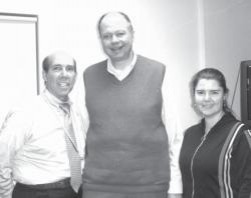
Steven Nobel, Bob Singleton & Christina Wilkinson
The Times Newsweekly in their November 12, 2009 edition, published an article entitled "Spanning Queens for its History" about Newtown Historical Society's Queensboro Bridge lecture at the Middle Village branch of the Queens Borough Public Library.
Newtown Historical's statement with regards to the Payntar millstones at Queens Plaza
The Payntar millstones are endangered by the reconstruction of Queens Plaza. Please read the following and see Newtown Historical's letter to the Queens Civic Congress below.
Colonial-era millstones in danger at Queens Plaza construction site, preservationists peeved [Daily News]
Where there's a mill...there's a way [Forgotten-NY]
History of the millstones [Greater Astoria Historical Society]
There will be a meeting about the preservation of the millstones on Wednesday, November 18th at the Quinn Building, located at 35-20 Broadway, 4th Floor in Astoria.
Colonial-era millstones in danger at Queens Plaza construction site, preservationists peeved [Daily News]
Where there's a mill...there's a way [Forgotten-NY]
History of the millstones [Greater Astoria Historical Society]
There will be a meeting about the preservation of the millstones on Wednesday, November 18th at the Quinn Building, located at 35-20 Broadway, 4th Floor in Astoria.
Special event at the Middle Village Library October 26th:
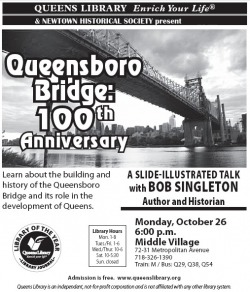
The Newtown Historical Society is pleased to present a slide illustrated talk about the history of the Queensboro Bridge as part of our free programming.
The Queensboro Bridge, perhaps even more than the Unisphere, is the symbol of the borough. For decades after its completion in 1909, writers would report statistics about Queens - population growth, employment, real estate valuation – by comparing the years before the bridge was built to the decades following. A vast tract of farms and meadows broken only by scattered hamlets became a home for millions almost overnight. The opening of the bridge was the single most important event that made the modern borough of Queens.
Noted author and historian, Bob Singleton, will share his work in a free slide illustrated talk at the Middle Village Branch of the Queens Borough Public Library on Monday, October 26 at 6 PM. Singleton is past president of the Greater Astoria Historical Society, which teamed up with the Roosevelt Island Historical Society this year for the 100th Anniversary of the Queensboro Bridge.
The Middle Village Branch of the Queens Borough Public Library is located at 72-31 Metropolitan Avenue. For more information about this event, please call the library at 718-326-1390 or log onto www.newtownhistorical.org.
The Queensboro Bridge, perhaps even more than the Unisphere, is the symbol of the borough. For decades after its completion in 1909, writers would report statistics about Queens - population growth, employment, real estate valuation – by comparing the years before the bridge was built to the decades following. A vast tract of farms and meadows broken only by scattered hamlets became a home for millions almost overnight. The opening of the bridge was the single most important event that made the modern borough of Queens.
Noted author and historian, Bob Singleton, will share his work in a free slide illustrated talk at the Middle Village Branch of the Queens Borough Public Library on Monday, October 26 at 6 PM. Singleton is past president of the Greater Astoria Historical Society, which teamed up with the Roosevelt Island Historical Society this year for the 100th Anniversary of the Queensboro Bridge.
The Middle Village Branch of the Queens Borough Public Library is located at 72-31 Metropolitan Avenue. For more information about this event, please call the library at 718-326-1390 or log onto www.newtownhistorical.org.
NEWTOWN HISTORICAL SOCIETY PLANTS HISTORIC APPLE TREES IN MASPETH, MIDDLE VILLAGE & RIDGEWOOD
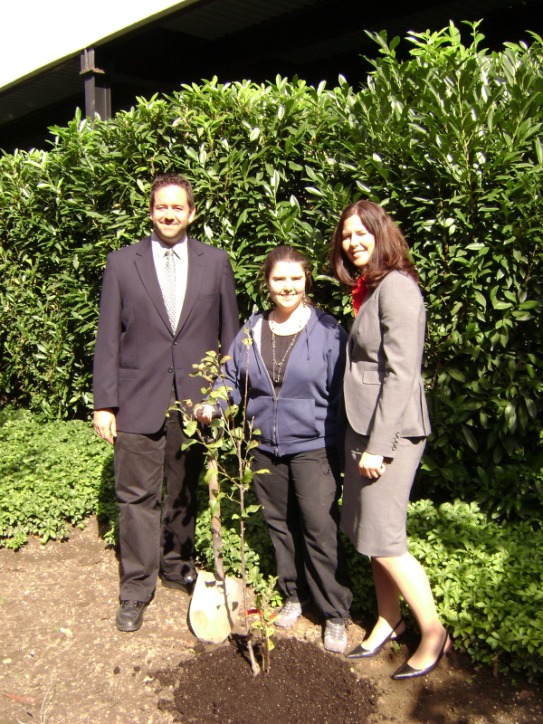
(L to R) David Daraio, Assistant Vice President, Maspeth Federal Savings, Christina Wilkinson, President, Newtown Historical Society & Council Member Elizabeth Crowley celebrate the planting of the Newtown Pippin tree at Maspeth Federal Savings.
(October 5, 2009) The Newtown Historical Society, in conjunction with The Newtown Pippin Project, identified 3 locations at which to plant historic Newtown Pippin apple trees, bringing the fruit back to its place of origin. The fruit trees were planted today at Maspeth Federal Savings, the Middle Village 75th Street Block Association’s community garden and at Ridgewood’s Onderdonk House.
The Newtown Pippin variety of apple was named after the western area of Queens, once known as Newtown Township. The original apple tree was located on the Gershom Moore farm along a tributary of Newtown Creek in the 1700s. From it, cuttings were taken and planted in orchards throughout the world. The apples were cultivated by some of our country’s founding fathers, including George Washington and Thomas Jefferson.
As part of a history and environmental project, the Newtown Pippin Project is offering free Pippin trees for planting throughout the city, with added emphasis on locations in western Queens, where the Pippin once grew and was first discovered by colonial Americans. Thanks to a sponsorship from Green Apple Cleaners, care and guidance from the NYC Department of Parks and Recreation, and pioneering local orchard replenishment by Slow Food NYC, a distributed orchard is being created among the city’s open spaces.
The Newtown Historical Society scouted out locations suitable for the trees and volunteers planted them in Maspeth and Middle Village on Monday, October 5th. (The staff of the Ridgewood Historical Society planted the trees at the Onderdonk House after Newtown delivered them.) The planting consists of a Newtown Pippin tree and a pollinator tree. The Onderdonk House received an Elstar apple tree as a pollinator, which is a Dutch variety. The other two locations received St. Edmund's Russet trees.
“The Newtown Pippin represents an important part of our agricultural history which is often overlooked,” said Christina Wilkinson, President of the Newtown Historical Society. “We hope by bringing a little bit of it back, we can use it as a teaching tool to help people understand the rural past of this area and the once-pristine condition of Newtown Creek.”
Erik Baard, Outreach Coordinator for the Newtown Pippin Project, said, “Let the abundance of these trees, and those to come, remind us of how lush and fertile the Newtown Creek and the surrounding city once were, and inspire our actions.”
"I commend Christina Wilkinson for her leadership in bringing back Maspeth's own Newtown Pippin tree," said Council Member Elizabeth Crowley. "As a member of the Environmental Protection committee, I am working with my colleagues to restore the growth of these beautiful trees through New York City and to declare the Newtown Pippin the official apple of the Big Apple!"
The trees may bear their first fruits by 2011. For the next planting in Spring 2010, Newtown Historical Society will focus on bringing the trees to area schools, houses of worship and cemeteries.
For more information about the Newtown Pippin Project, please visit www.newtownpippin.org or www.newtownhistorical.org.
The Newtown Pippin variety of apple was named after the western area of Queens, once known as Newtown Township. The original apple tree was located on the Gershom Moore farm along a tributary of Newtown Creek in the 1700s. From it, cuttings were taken and planted in orchards throughout the world. The apples were cultivated by some of our country’s founding fathers, including George Washington and Thomas Jefferson.
As part of a history and environmental project, the Newtown Pippin Project is offering free Pippin trees for planting throughout the city, with added emphasis on locations in western Queens, where the Pippin once grew and was first discovered by colonial Americans. Thanks to a sponsorship from Green Apple Cleaners, care and guidance from the NYC Department of Parks and Recreation, and pioneering local orchard replenishment by Slow Food NYC, a distributed orchard is being created among the city’s open spaces.
The Newtown Historical Society scouted out locations suitable for the trees and volunteers planted them in Maspeth and Middle Village on Monday, October 5th. (The staff of the Ridgewood Historical Society planted the trees at the Onderdonk House after Newtown delivered them.) The planting consists of a Newtown Pippin tree and a pollinator tree. The Onderdonk House received an Elstar apple tree as a pollinator, which is a Dutch variety. The other two locations received St. Edmund's Russet trees.
“The Newtown Pippin represents an important part of our agricultural history which is often overlooked,” said Christina Wilkinson, President of the Newtown Historical Society. “We hope by bringing a little bit of it back, we can use it as a teaching tool to help people understand the rural past of this area and the once-pristine condition of Newtown Creek.”
Erik Baard, Outreach Coordinator for the Newtown Pippin Project, said, “Let the abundance of these trees, and those to come, remind us of how lush and fertile the Newtown Creek and the surrounding city once were, and inspire our actions.”
"I commend Christina Wilkinson for her leadership in bringing back Maspeth's own Newtown Pippin tree," said Council Member Elizabeth Crowley. "As a member of the Environmental Protection committee, I am working with my colleagues to restore the growth of these beautiful trees through New York City and to declare the Newtown Pippin the official apple of the Big Apple!"
The trees may bear their first fruits by 2011. For the next planting in Spring 2010, Newtown Historical Society will focus on bringing the trees to area schools, houses of worship and cemeteries.
For more information about the Newtown Pippin Project, please visit www.newtownpippin.org or www.newtownhistorical.org.